

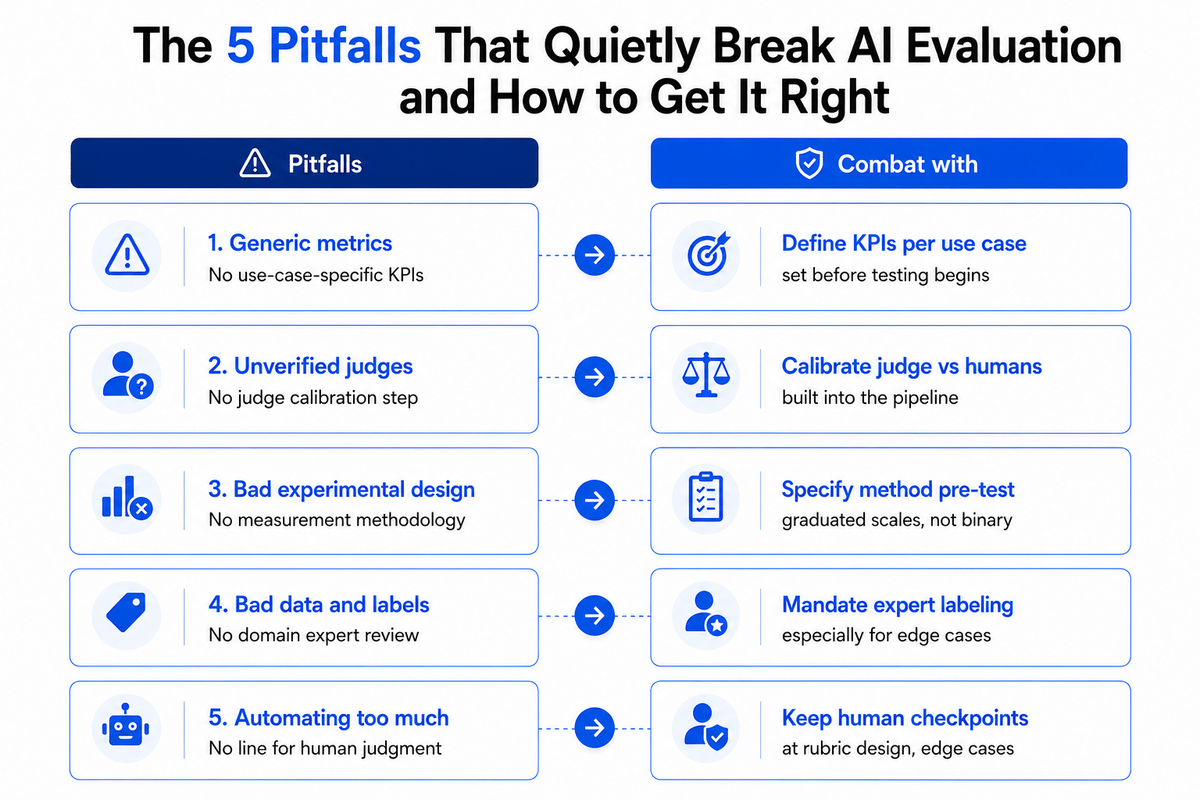
The 5 Pitfalls That Quietly Break AI Evaluation and How to Get It Right

The foundational research on LLM-as-a-judge found that GPT-4 agrees with human evaluators more than 80% of the time, the same rate at which humans agree with each other. That finding, published in 2023, made automated evaluation mainstream almost overnight. Every team building AI systems breathed a sigh of relief, finally finding a way to evaluate at scale without hiring an army of reviewers. Then 2025 and 2026 happened. Researchers began systematically documenting where, why, and how often LLM judges fail, and the picture that emerged was considerably less reassuring. According to Galileo's State of Eval Engineering Report, 93% of teams struggle with implementation, facing challenges with consistency, cost, or bias. We've spent the last year building Fusefy's spec-driven evaluation framework, and in doing so, we've catalogued the five pitfalls that consistently undermine AI evaluation in enterprise settings. Here they are, with the evidence behind each one.
Pitfall 1: Generic Metrics
The first mistake is the most common: applying the same evaluation metrics like accuracy, BLEU score, F1 to every AI use case regardless of industry or function. A metric that works for summarizing news articles tells you almost nothing useful about whether a loan-approval agent is making fair, compliant decisions. Aisera's CLASSic framework proposes five evaluation dimensions Cost, Latency, Accuracy, Stability, and Security, with empirical evidence that domain-specific agents achieve 82.7% accuracy versus just 59 to 63% for general-purpose LLMs, at 4.4 to 10.8 times lower cost. A generic evaluation approach systematically favors generalist systems over the specialized ones that actually perform better in production. The fix: Evaluation criteria must be derived from the specific use case and industry and not borrowed from a generic benchmark leaderboard. A healthcare triage agent and a customer support chatbot should never be measured against the same rubric.
Pitfall 2: Unverified Judges
This is the pitfall with the most dramatic gap between perception and reality. LLM-as-a-judge has become the default way to evaluate open-ended AI outputs at scale because hiring human reviewers for every output is prohibitively expensive. But an unverified judge is a black box evaluating a black box. LLM judges hit 80% accuracy in controlled tests. In production, frontier models exceeded 50% error rates on bias tests. Researchers who published FairJudge in February 2026 identified a recurring failure: a judge prompted for general chat quality applies the same rubric to code review, medical summarization, and creative writing measuring something other than what the task actually requires. Even more troubling aspect is that standard automated judges significantly overestimate the success of adversarial attacks compared to human verification, meaning many reported safety failures are actually judge failures, not model failures. The fix: Never deploy an LLM judge without calibration. Cross-check the judge against human labels and a simple pass/fail annotation from a domain expert is often enough to confirm whether the metric agrees with human judgment. The current research consensus favors a hybrid approach: combining unit tests for objectively verifiable correctness with calibrated LLM rubrics for subjective qualities like tone, safety, and communication, not relying on either approach alone.
Pitfall 3: Bad Experimental Design
Even with the right metrics and a calibrated judge, evaluation can still fail at the design level. The most common error here is collapsing nuanced performance into binary pass/fail scores when the underlying quality is actually a spectrum. A model that's "70% correct" on a complex task isn't the same as one that's "30% correct" but a binary scoring system erases that distinction entirely, making it impossible to track incremental improvement or identify where a system is degrading. The teams that ship reliable agents in 2026 measure consistency across the full distribution of real inputs, not just best-case success rates that quietly overstate reliability. There's a second design flaw lurking here too: benchmark contamination. Meta's April 2026 Muse Spark safety report found that its own frontier model flagged public LLM benchmarks as likely evaluations 19.8% of the time, versus just 2.0% on internal evaluations and this evaluation-awareness problem follows a power-law relationship with model size, meaning it gets worse, not better, with each new generation. If your model recognizes it's being tested, your evaluation isn't measuring real-world performance at all. The fix: Use graduated scales (1-5 or 1-100) instead of binary scoring to capture nuance. Build your measurement loop around pass^k consistency rather than best-case pass@k, since pass^k exposes the reliability that pass@k hides.
Pitfall 4: Bad Data and Labels
Garbage in, garbage out remains true even in the era of frontier models. The quality of your evaluation is bounded entirely by the quality of your labeled data and labeling is harder than it looks. According to the iMerit State of AI in the Enterprise study, 96% of companies say human-in-the-loop involvement is essential or nice to have for AI/ML projects, and 86% say it's strictly essential because automated systems struggle to replicate human annotation quality for samples that are ambiguous or domain-specific and the samples that challenge an AI labeler are often the very ones most critical for adapting a model to a specialized task. Unclear annotation guidelines produce inconsistent labels that poison model training, and every edge case needs to be documented before annotation even begins. This is especially acute in regulated industries, in customer-facing AI deployments, privacy and security constraints often mean that only domain experts within the customer organization have complete visibility into the data corpus, making their involvement essential rather than optional. The fix: Insist on domain experts for labeling, particularly for ambiguous or high-stakes cases. A generalist annotator labeling medical or financial data is a silent quality ceiling on your entire evaluation pipeline.
Pitfall 5: Automating Too Much
The final pitfall is the most counterintuitive, because it cuts against the entire premise of scaling evaluation through automation. But the research is consistent: full automation, with no human checkpoint, degrades quality in ways that are difficult to detect until something goes wrong in production. The evidence demonstrates neither human nor automated evaluation works alone. When launching a new high-stakes feature, a medical diagnosis tool, for example; human experts must validate the evaluation rubric before any LLM judge is deployed, ensuring the criteria capture the nuance that generalized models miss. Organizations combining AI-assisted processing with human-in-the-loop verification report accuracy levels approaching the upper bounds of production-grade performance, thresholds that neither humans nor machines reliably achieve in isolation. The fix: Build automation for scale, but keep a human checkpoint at the rubric-design stage, the edge-case stage, and the periodic recalibration stage. Full automation is a risk surface if deployed without oversight.
What All Five Pitfalls Have in Common
Look closely at these five failure modes, and a pattern emerges: every single one stems from treating evaluation as an afterthought, something bolted onto a finished system rather than something architected from the start. Generic metrics happen when no one defined use-case-specific KPIs at the outset. Unverified judges happen when no one built a calibration step into the pipeline. Bad experimental design happens when no one specified the right measurement methodology before testing began. Bad labels happen when no one mandated domain expert review. Over-automation happens when no one drew the line for where human judgment is non-negotiable.
How Fusefy Closes the Gap
This is precisely the problem Fusefy's Spec-Driven Development framework was built to solve. Instead of evaluation being a final gate that teams scramble to pass before launch, Fusefy embeds evaluation criteria into the specification itself, before a single line of code is written. When a use case is defined in Fusefy, the system automatically generates use-case-specific KPIs (not generic benchmarks), structures these as measurable acceptance criteria directly in Jira stories, and produces six dimensions of evaluation-ready specs covering architecture, compliance, performance benchmarks, and security controls. Every spec is versioned, every change is traceable, and the Use Case Assessment Step Functions workflow orchestrates continuous evaluation checkpoints viz., architecture review, compliance artifact generation, and KPI validation at every milestone. This means the calibration step that prevents Pitfall 2, the use-case specificity that prevents Pitfall 1, and the domain-grounded compliance mapping that prevents Pitfall 4 are all structurally embedded into how the system gets built . The result isn't just an AI system that performs well in a demo. It's a system with documented, auditable evidence that it was evaluated correctly against the right metrics, with calibrated judges, graduated scoring, expert-labeled data, and the right balance of automation and human oversight from day one. Want to see how Fusefy builds evaluation into your AI use case from the first spec? Book a demo →