
AI-Native Business Discovery & Matchmaking Platform

As professional communities and campus-based business networks grow, connecting the right businesses to the right partners, vendors, and service providers becomes harder to do by hand. We built an AI-native system to close that gap. The system turns scattered business information into a searchable, self-service discovery and matchmaking layer, without slowing down the core application members and admins rely on every day.
Key Challenges
Before our engagement with the client, they ran into the same operational bottlenecks:
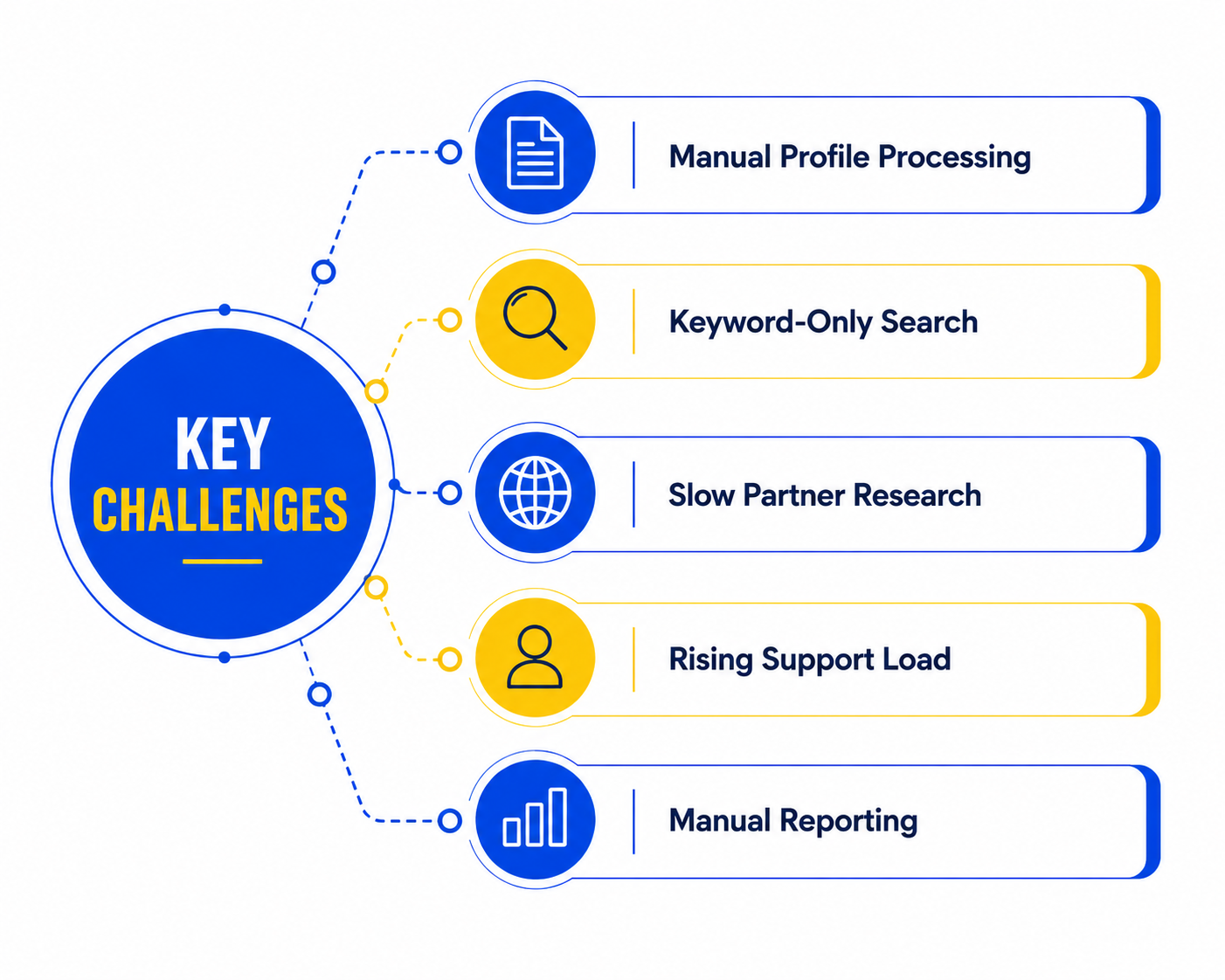
- Manual profile processing: every submitted business document needed a person to read it, extract the services and experience behind it, and re-enter that into a searchable format.
- Keyword-only search: without semantic understanding, finding the right business meant scrolling member lists instead of describing the actual need in plain language.
- Slow partner research: assessing a prospective partner's industry, services, and fit required manual web research, one company at a time.
- Rising support load: members and admins asked the same routine questions about businesses and the platform, and every answer consumed admin time.
- Manual reporting: turning a search or shortlist into something shareable meant hand-assembling a document each time.
Our Solution
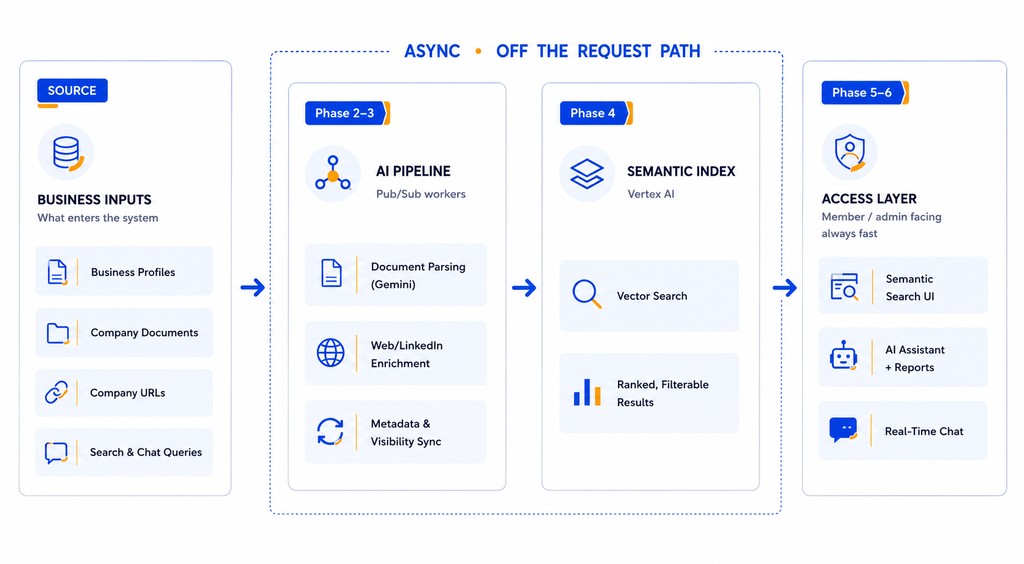
The platform addresses each of these with a purpose-built AI layer over a production three tier system, delivered across seven phases from foundation to fully self-service AI access. So, AI processing scales independently of the request path.
PHASE 1
Platform Foundation
A Next.js frontend and FastAPI backend over async SQLAlchemy, backed by PostgreSQL (Cloud SQL in production). Organizations run as isolated tenants with scoped member, org-admin, and platform-admin roles. This tier stays free of LLM calls so response times hold steady regardless of AI load.
PHASE 2
Business Profile Ingestion
A Pub/Sub-triggered business document parser reads uploaded profiles and documents, using Gemini to extract structured fields-services offered, experience, company summary-entirely off the request path.
PHASE 3
Enrichment & Standardization
An enrichment worker combines web and LinkedIn data retrieval with Gemini reasoning to infer a business's industry, services, and partnership intent from a company URL alone; a metadata sync worker keeps visibility rules consistent as the network changes.
PHASE 4
Semantic Search & Matchmaking
Business profiles are indexed in Vertex AI Vector Search, turning natural-language queries into ranked, filterable results by location, rate, experience, and availability.
PHASE 5
Conversational AI & Reporting
An agent built on Gemini and Google's Agent Development Kit is equipped with a search tool for semantic discovery and a document tool that generates PDF/DOCX reports on demand, delivered through signed, time-limited GCS URLs.
PHASE 6
AI Marketing & Outreach
The AI marketing assistant analyzes a business's profile and outreach objectives to generate personalized LinkedIn posts, email campaigns, and other marketing content tailored to the business's industry, audience, and goals. By combining structured business metadata with AI-driven content generation, organizations can launch consistent, high-quality outreach, engage prospective customers and partners more effectively, and significantly reduce the manual effort required to create marketing content.
PHASE 7
Real-Time Collaboration
Firestore-backed messaging keeps member-to-member conversations responsive, independent of backend load.
Overall Solution Architecture
AI-Native Business Discovery Platform
Business Impact
- Reduced manual effort: business documents are parsed into structured, searchable data automatically on upload, removing manual data entry from the intake process.
- Improved business discovery and matchmaking: natural-language semantic search replaces list-scrolling and keyword filters, surfacing relevant businesses by actual need.
- Automated B2B research and reporting: enrichment infers industry, services, and partnership intent from a URL alone, and the document tool turns any search into a shareable, professional report on request.
- Accelerated marketing and outreach: AI-generated LinkedIn posts, email campaigns, and personalized outreach content help organizations engage prospective customers and partners faster while reducing manual content creation.
- Reduced support workload: the AI assistant answers routine member and admin questions directly, cutting back-and-forth that used to require admin intervention.
- Accelerated business partnerships: compressing discovery, research, reporting, and AI-assisted outreach into a single intelligent workflow gets organizations to the right partners, customers, vendors, and collaborators faster than manual processes allow.
Conclusion
This case study shows how a purpose-built AI layer can turn a passive business directory into an active business growth platform. One that reads, searches, researches, and creates outreach content at the speed business development actually needs. By keeping AI processing asynchronous and tool-based rather than baked into every request, the platform adds real intelligence without trading away the speed and reliability of the core product. The result is a scalable foundation ready to support more organizations, richer enrichment, deeper AI-assisted discovery, and intelligent marketing automation as the network grows.