The world of Artificial Intelligence is rapidly moving from isolated chatbots to complex, collaborative AI Agents that can plan, reason, and act to achieve goals. As this ecosystem grows, three protocols have emerged as critical standards for making these agents truly functional and interoperable: the Model Context Protocol (MCP), the Agent Communication Protocol (ACP) and the Agent-to-Agent (A2A) Protocol.
While their names sound similar, they solve two distinct, yet complementary, problems. Understanding how they work together is key to building the next generation of reliable, and powerful AI applications.
Model Context Protocol (MCP): Tool Integration Layer
The Model Context Protocol (MCP), introduced by Anthropic, is all about enriching the capabilities of a single AI model or agent. It addresses the fundamental problem of model isolation: an LLM is powerful, but without external data, it’s trapped in a silo of its training data.
What MCP Does:
- Contextualizes the Model: MCP provides a standardized way for an LLM to access external tools and data sources (like a company database, a live API, or a file system), serving as the foundation for Agent external API integration.
- A “Universal Remote” for Tools: Instead of developers writing custom integration code for every single data source, MCP defines a single, uniform way for the model to make “tool calls.”
- Enhances Decision-Making: By giving the model real-time access to accurate, external context, MCP dramatically improves the model’s ability to reason and make informed decisions.
Think of MCP as giving an AI agent the perfect toolbelt and a full library of up-to-date reference books that help the agent know what it needs to know, when it needs to know it.
Agent Communication Protocol (ACP): Enabling Collaboration
The Agent Communication Protocol (ACP), championed by IBM Research and the Linux Foundation, is designed for the scenario that happens after an agent is smart and capable: it needs to talk to other agents.
What ACP Does:
- Standardizes Interoperability: ACP defines the rules, language, and structured message formats for how two or more independent AI agents can securely communicate, delegate tasks, and exchange information.
- Enables Multi-Agent Systems: It allows agents built by different teams, using different frameworks (e.g., a LangChain agent and a CrewAI agent), to work together seamlessly in a distributed workflow.
- Facilitates REST-based Interaction: Unlike MCP’s typical JSON-RPC, ACP is REST-first, which makes it simple to integrate into production environments using standard HTTP tools, lowering the barrier for agent-to-agent integration.
Think of ACP as providing the common diplomatic language and the meeting structure for a team of specialists. It allows the logistics agent, the inventory agent, and the finance agent to work together to fulfill a complex customer order.
A2A : The Protocol of AI Teamwork
Agent-to-Agent (A2A) refers to the standardized, automated communication and task delegation between multiple independent, specialized AI agents. It is the core mechanism that allows an ensemble of AI specialists to collaborate on a single, complex enterprise workflow.
What A2A Does
A2A is essential for moving beyond individual AI tasks to building resilient, fully automated business processes that require collaboration.
- Enables Multi-Agent Systems: A2A provides the necessary protocols for distinct, specialized agents (e.g., a financial agent, a customer service agent, and a logistics agent) to securely exchange data and delegate subtasks in real-time.
- Facilitates Complex Workflow Orchestration: It allows business processes that span multiple functional domains to be executed seamlessly. For example, a single customer request can be automatically routed through a triage agent, a knowledge retrieval agent, and finally an execution agent.
- Standardizes Interoperability: A2A relies on structured messaging formats and APIs to ensure that agents built using different underlying large language models (LLMs) or frameworks can “speak the same language,” making the overall system robust and scalable.
- Drives Efficiency Through Specialization: By enabling agents to hand off tasks, A2A ensures that each agent focuses only on its area of expertise, maximizing efficiency and accuracy across the entire automated value chain.
Think of A2A as creating a virtual organizational chart where every agent knows its role, its boundaries, and exactly how to pass information to the next specialist in the chain to drive seamless, end-to-end automation.
The Synergistic Workflow: MCP with ACP and A2A
In a multi-agent system architecture, this MCP-ACP-A2A trio creates resilient, multi-agent flows where agents negotiate, access context, and execute without human handoffs.
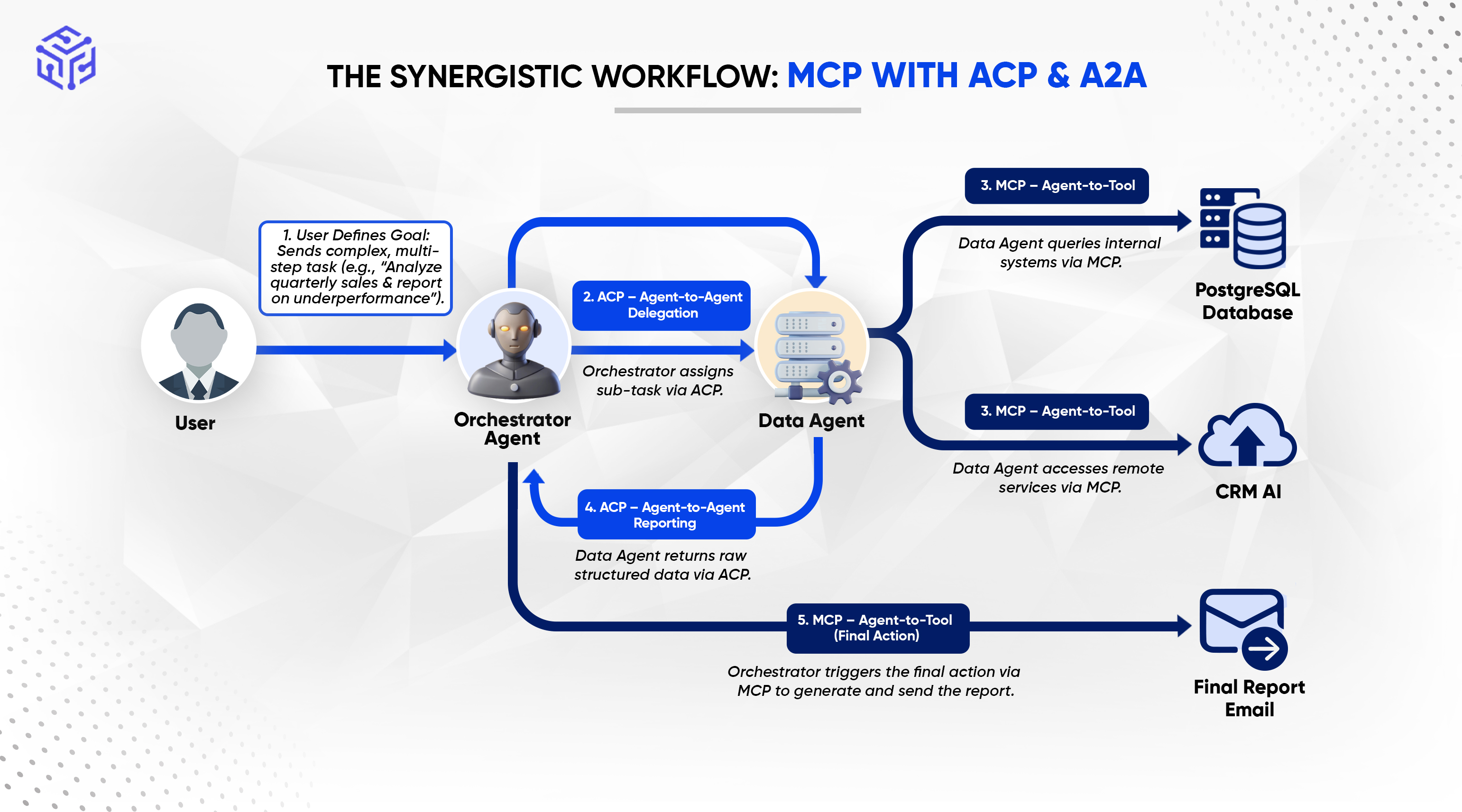
- The Starting Goal: A human user gives a central “Orchestrator Agent” a complex, multi-step goal (e.g., “Analyze last quarter’s sales and generate a report on regional underperformance.”).
- ACP for Delegation: The Orchestrator Agent (using ACP) communicates with a specialized “Data Agent” and delegates the task of fetching raw numbers.A2A enables direct chat for clarifications.
- MCP for Context: The Data Agent, to execute its delegated task, makes an MCP tool call to securely query the company’s internal PostgreSQL database and a remote CRM API.
- ACP for Reporting: The Data Agent returns the structured raw data to the Orchestrator Agent via ACP.A2A confirms quality in real-time
- Final Action: The Orchestrator Agent then processes this data (which was retrieved using MCP) and uses a final tool call (via MCP) to draft and send the final report email.
In this scenario, MCP ensures each agent has the tools and data it needs to perform its individual step, while ACP provides the connective tissue for the entire workflow to execute collaboratively and at scale. A2A enables real-time collaboration between agents, allowing dynamic task clarification and secure handoffs across platforms.
This trio: MCP for tools, ACP for orchestration, A2A for adaptive collaboration,powers resilient, enterprise-grade agent swarms.
AUTHOR

Sivakumar Chellappa
With extensive expertise in Data, Cloud, Analytics and AI, Sivakumar Chellappa drives innovative data-driven solutions that bridge technology and business strategy
Similar Vibes


Top Vibes