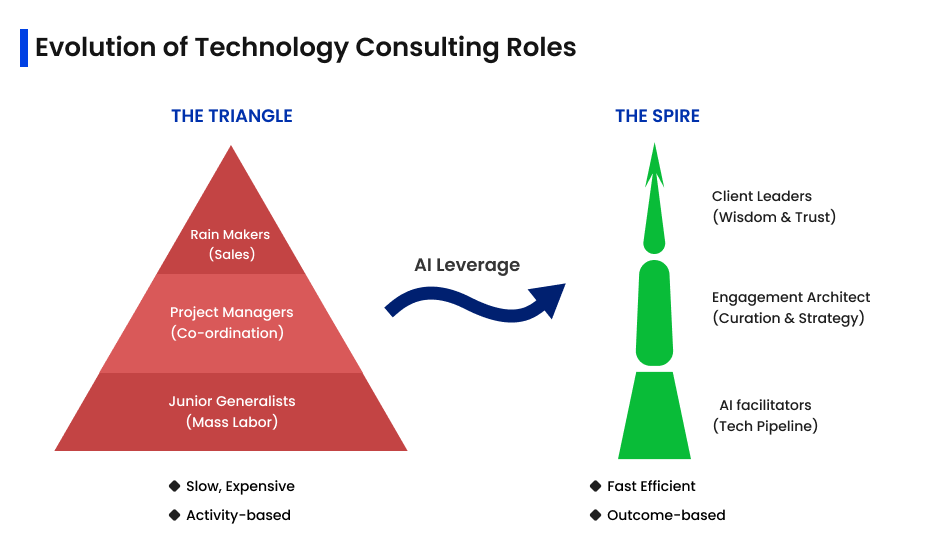
The management consulting industry’s historic reliance on The Triangle: a costly, slow model using an army of junior generalists to justify thousands of billable hours, is officially over. The digital revolution has exposed this structure as an inefficient trap for clients, as AI now executes the data-crunching and slide-building tasks that previously inflated invoices.
Clients no longer need generalists; they need surgical, specialized expertise.
This shift is driving the collapse of the traditional Pyramid, giving way to The Spire: a lean, vertical structure built for deep specialization, rapid execution, and verifiable, outcome-focused results.
Enter the Spire: Precision Over Mass
The Spire relies on leverage and technical precision. In this model, the “middle” doesn’t just manage juniors; it actively produces value using AI. The “bottom” isn’t about rote learning; it’s about technical facilitation. This fundamental shift is creating three distinct, evolved roles that will define the next generation of consulting, replacing the costly inefficiency of the past with targeted excellence.
The Three Pillars of The Spire: New Roles, New Value
Each layer of the Spire is engineered to deliver disproportionate value, moving from measuring effort to measuring impact.
1. The AI Facilitator (The Base of the Spire)
Replacing the grunt work with architectural precision.
- The Old Way:
An “Analyst” spending 80 hours a week cleaning Excel sheets, manually formatting slides and reports, and relying heavily on repetitive, time-consuming tasks. - The New Way:
A specialized technologist who designs AI-driven workflows, allowing automation to handle data processing and analysis at scale. - The Role:
Professionals who build and manage AI pipelines, handle prompt engineering and data ingestion, ensure accurate and relevant information retrieval, replace large teams of generalists with a small elite squad of tech-fluent operators, and drive rapid, data-driven execution.
2. The Engagement Architect (The Core of the Spire)
Moving from coordination to curation.
- The Old Way:
The “Project Manager” who coordinated schedules and tracked deliverables. - The New Way:
A strategic conductor who bridges the gap between AI speed and human judgment. - The Role:
This is the structural core of the Spire. Because AI can generate infinite content, the Architect’s job is curation and validity. They define the problem, interpret the AI’s output, and apply the “so what?” logic that machines still struggle with. They must possess deep industry acumen to validate the machine’s findings and synthesize output into a coherent, actionable narrative. They ensure the speed of AI doesn’t outpace the quality of the strategy.
3. The Client Leader (The Peak of the Spire)
From sales to sense-making.
- The Old Way:
The “Rainmaker” who sold the work, shook hands, and moved on. - The New Way:
The “Sense-Maker” who stays deeply embedded to help executives navigate disruption. - The Role:
With the delivery cycle compressed by AI, these leaders focus entirely on the human element: trust, nuance, and courage. Their value is no longer access to an army of analysts, but their ability to provide wisdom and trusted counsel in a chaotic market. They translate the Spire’s technical output into executive action, moving beyond merely presenting data to guiding transformational change.
Lets consider the example of a Supply Chain Resilience Project
Client: A multinational Automotive Manufacturer facing frequent, unpredictable component shortages due to geopolitical risks and natural disasters.
Project Goal: Identify, quantify, and mitigate the Top 5 supply chain risks in 90 days.
| Spire Role | The Old Way (Triangle) | The New Way (Spire) | Outcome |
|---|---|---|---|
| 1. AI Facilitator (Base) | The Old Analyst: A team of 10 junior analysts spent 6–8 weeks manually compiling supplier contracts, customs data, and transportation logs into Excel, resulting in a static and often outdated data set. | The AI Facilitator: A squad of 2 specialists built a proprietary AI pipeline in 3 days. The pipeline ingested all data, cross-referenced it with live geopolitical risk APIs and weather models, and produced a dynamic, risk-scored list of 5,000 suppliers. | Time saved: 98% of data compilation time. Output: A live, interactive risk dashboard instead of a static report. |
| 2. Engagement Architect (Core) | The Old Project Manager: Spent 50% of their time tracking analyst hours, managing data compilation, and ensuring presentation slides were consistently formatted. | The Engagement Architect: A single senior expert focused entirely on curation and strategy. They reviewed the AI’s top 50 risk flags, validated outputs with regional experts, and synthesized five critical, actionable risk scenarios. | Focus Shift: From managing activity to managing strategic insight. The Architect moved immediately to the “so what?” and solution design. |
| 3. Client Leader (Peak) | The Old Rainmaker: Presented a pre-packaged solution, focused on selling the next phase, with limited involvement in implementation details. | The Client Leader : Embedded with the client’s C-suite from Week 1, running real-time scenario planning workshops and guiding human decision-making around sourcing and contracts. | Value Delivered: Not a report, but courageous executive action. The manufacturer implemented two major supplier diversification strategies within the project timeline, immediately reducing future risk exposure. |
The Spire Advantage
In this example, The Triangle would have spent 6-8 weeks compiling data and another 4 weeks analyzing it, resulting in a costly, static report delivered 3 months later. The Spire, by contrast, leveraged two AI Facilitators to complete the data work in days. This allowed the Engagement Architect to spend weeks on high-value synthesis, enabling the Client Leader to deliver final, validated, and executable strategies in half the time.
The manufacturer paid for precision and speed, not labor hours. This is the new law of value in consulting.
The Bottom Line: The New Law of Value
The era of billing for “effort” is over.
The Spire model proves that modern consulting isn’t about how many hours you work, it’s about the precision of the tools you build and the wisdom of the counsel you provide.
For executive clients, this means a dramatic reduction in cost-to-solution and a profound increase in strategic velocity. The question is no longer how many consultants you need, but how specialized they are.
AUTHOR

Ramesh Karthikeyan
Ramesh Karthikeyan is a results-driven Solution Architect skilled in designing and delivering enterprise applications using Microsoft and cloud technologies. He excels in translating business needs into scalable technical solutions with strong leadership and client collaboration.
Similar Vibes


Top Vibes