

Eval for AI Agents: A Comprehensive Guide

As AI agents pilot at a high speed, one question becomes increasingly important: how do we know they actually work as intended? Organizations need to understand whether their agents can reliably complete tasks, make appropriate decisions, use the right tools, follow defined policies, and perform consistently in real-world scenarios. This is where AI agent evaluation or AI Eval becomes the defining discipline of the agentic AI era. This guide breaks down what agent evaluation really means, the frameworks and benchmarks shaping it in 2026, where it still falls short, and how enterprises can close that gap.
Why Evaluating Agents Is Different from Evaluating Models
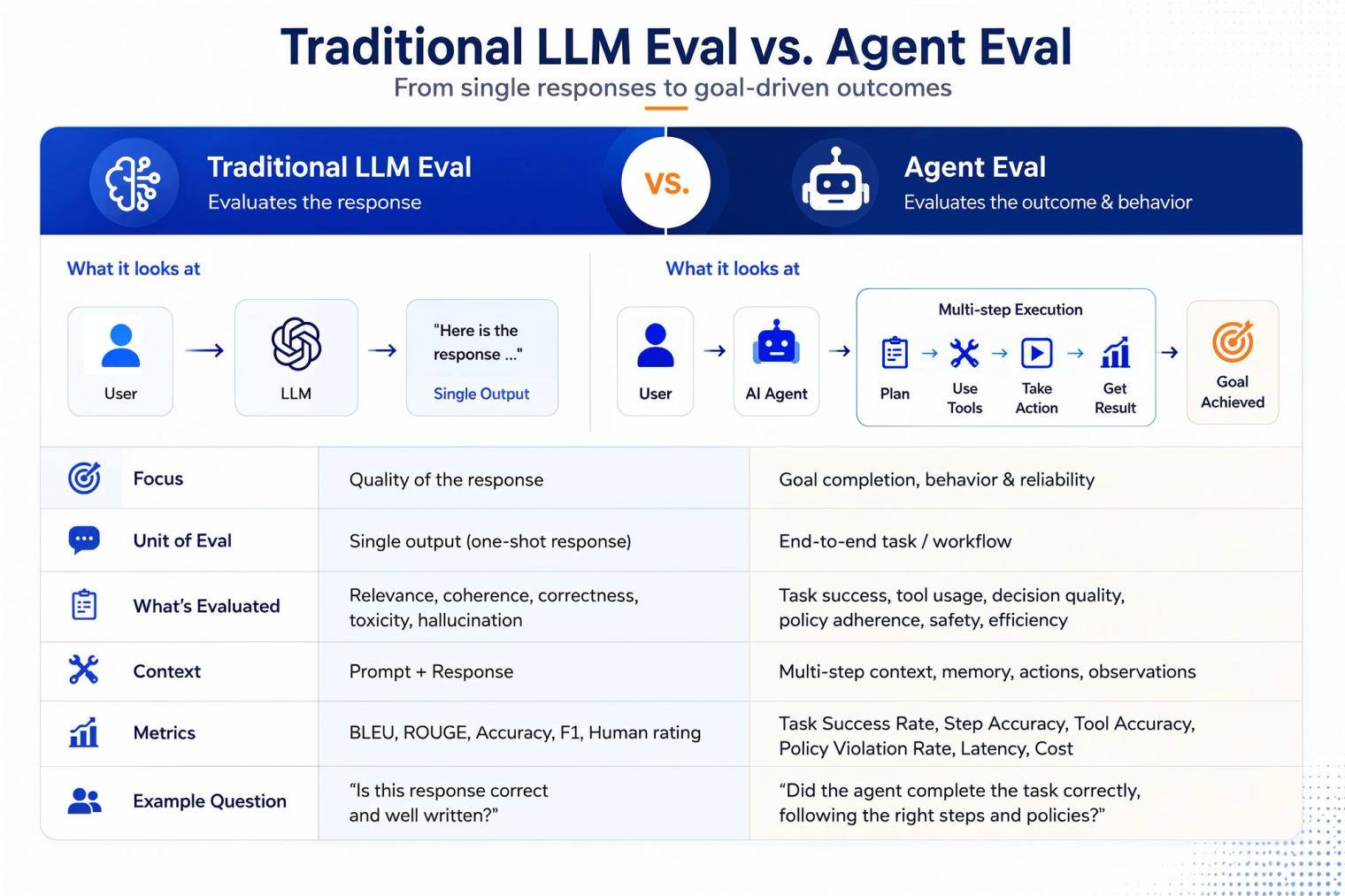
Traditional LLM evaluation asked whether a single response was accurate, relevant, or well-written. Agents break that model completely. An agent plans, calls tools, reads and writes to external systems, loops through multiple steps, and only then produces an outcome. Evaluating an agent means measuring whether a tool-using system does its job correctly across three layers: the final answer, the sequence of steps and tool calls it took to get there, and the meaning of each turn along the way.
This shift, from scoring an answer to scoring an entire trajectory, is why 2026 has been described as the year evaluation moved from measuring model answers to measuring multi-step execution across tool use, navigation, file handling, and recovery from failed steps. It turns agent testing into something closer to systems engineering than traditional NLP scoring.
The Core Dimensions of Agent Evaluation
A mature eval strategy typically looks at:
- Task completion - did the agent achieve the actual end goal, verified against the end state, not just a plausible-sounding output.
- Trajectory accuracy - did it take a sensible path, calling the right tools in the right order, without unnecessary loops or detours.
- Tool-call accuracy - did it choose and parameterize the correct API or function at each step.
- Groundedness and policy compliance - did it stay faithful to source data and organizational rules, especially in regulated workflows.
- Cost and latency - how many model and tool calls did it take, and at what price, since agents can make hundreds of API calls per task, with some iterative-refinement architectures running up to 2,000 calls for a single job.
Crucially, a high score on one dimension can mask failure on another. A customer service agent can hit perfect tool-call accuracy while still violating policy on edge cases, and a research agent can call every required API yet still produce a summary a domain expert would reject. This is why single-metric "accuracy" dashboards are increasingly seen as misleading on their own.
The Benchmark Landscape
A wave of public benchmarks now anchors agent evaluation, though each targets a different capability:
- SWE-bench tests real-world software engineering by having agents resolve actual GitHub issues, with Verified, Lite, Full, and Multilingual variants tracking different difficulty levels.
- WebArena and GAIA test web navigation and general tool-using reasoning; the 2026 AI Index reports GAIA accuracy at 74.5% and WebArena success at 74.3%, against a 78.24% human baseline, evidence that frontier agents are closing the gap with people but haven't matched them yet.
- τ-bench (tau-bench) introduces multi-turn conversations with policy constraints in domains like retail and airlines, exposing reliability issues through pass@k metrics rather than one-shot scoring.
- AgentBench and ToolLLM/Berkeley Function-Calling Leaderboard stress-test agents across operating systems, databases, and thousands of real APIs.
- WorkArena, built on ServiceNow, evaluates agents against actual knowledge-work tasks rather than synthetic ones.
On the tooling side, open-source and commercial frameworks like Ragas, DeepEval, LangSmith, Arize Phoenix, Braintrust, and OpenAI Evals let teams run these same categories of tests against their own agents and data rather than a fixed leaderboard. Ragas, born from an EACL 2024 research paper, established many of the metrics: faithfulness, answer relevancy, agent goal accuracy, and tool-call accuracy, that other frameworks later adopted.
Why Benchmarks Alone Aren't Enough
Public benchmarks are useful for comparing raw model capability, but enterprises find lab scores don't predict production behavior. Enterprise agentic AI systems have shown roughly a 37% gap between lab benchmark scores and real-world deployment performance, alongside up to 50x cost variation for similar accuracy. Benchmark data itself carries risk: audits of popular text-to-SQL benchmarks have found annotation error rates exceeding 50%, with static datasets prone to contamination and gaming.
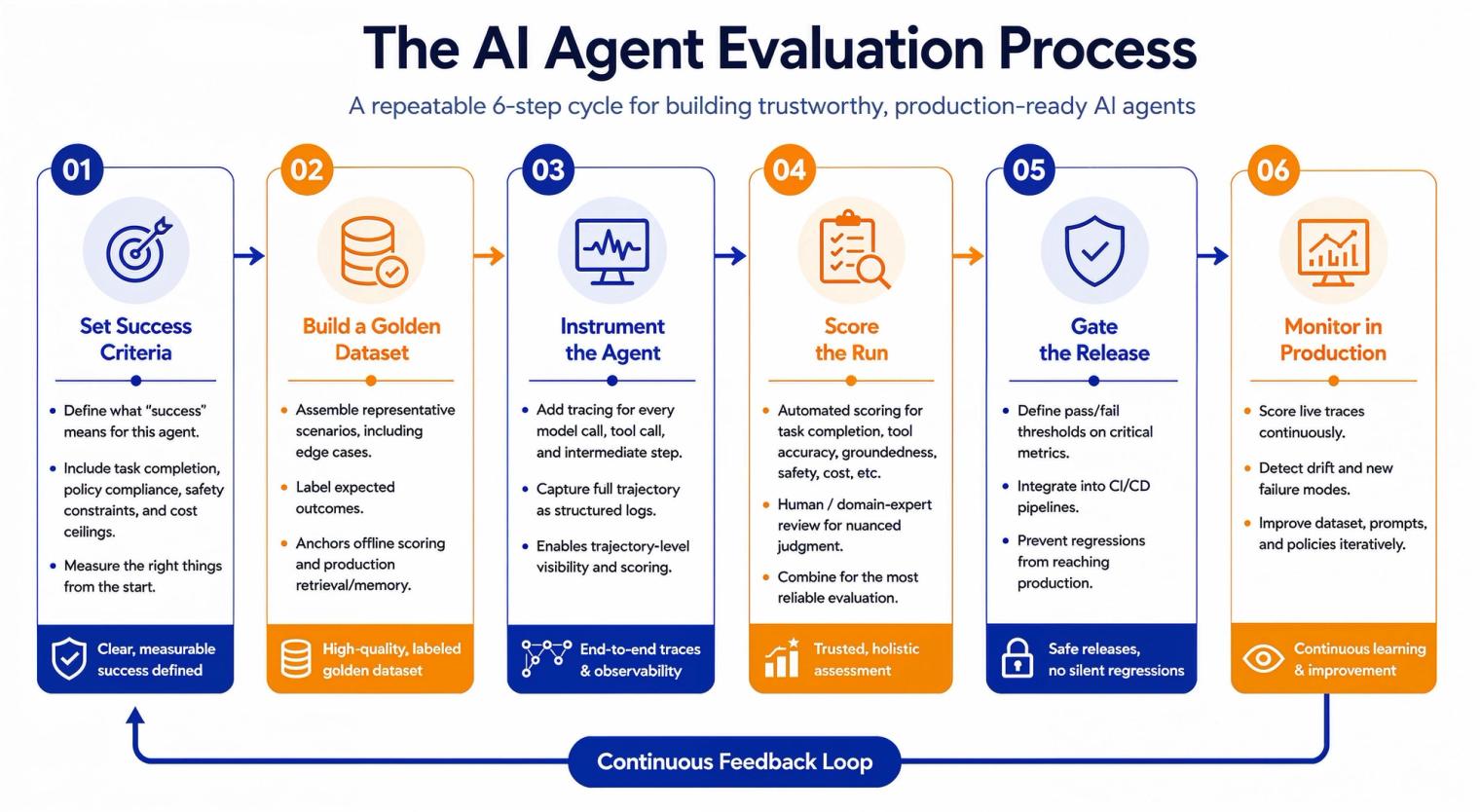
There's also a structural blind spot: every framework scores the dataset a team assembled, so once production traffic moves past that dataset, the suite is measuring a world that no longer exists. This is why leading practitioners now pair offline evaluation with continuous, production-trace monitoring rather than treating a one-time benchmark run as a pass/fail gate.
Real-World Eval Scenarios
Financial services, fraud and claims automation - Payer organizations building agents to validate claims codes and flag fraud need eval baked into the data layer, a governed "golden dataset" feeding both agent memory and the eval suite, so accuracy and PHI protection are checked continuously, with straight-through processing rates tracked as live KPIs.
Customer support agents - A support agent might resolve 95% of tickets correctly on task-completion metrics yet mishandle edge cases like refund exceptions or regulated disclosures, the policy-violation risk that pure tool-call accuracy hides, and why trajectory- and policy-level checks matter as much as final-answer scoring.
Software engineering copilots - Coding agents on SWE-bench Verified are judged on real, human-filtered GitHub issues which is a useful capability proxy, but teams still need repo-specific evals since benchmark performance and codebase-specific reliability often diverge.
How Fusefy Helps with Agent Evaluation
Fusefy is built to answer the harder enterprise question: whether the agent can be trusted to run in production, continuously, under real compliance obligations.
- Governed, code-grounded evidence, not one-off tests: Fusefy's spec-driven approach converts regulations like the EU AI Act, NIST, and ISO 42001 into machine-readable checks, so evaluation results are tied to auditable, continuously enforced controls rather than a static report.
- Full-lifecycle coverage: Through the FUSE framework, evaluation is embedded from ideation and pilot through deployment monitoring, spanning 50+ standards and 100+ use cases.
- Golden-dataset-driven accuracy: Fusefy builds certified, domain-specific datasets (for example, in healthcare claims or financial workflows) that anchor both agent memory and evaluation, closing the gap between generic benchmark scores and real operational accuracy.
- No vendor lock-in: Fusefy integrates directly with existing AWS, Azure, and GCP environments and your existing tools, meaning evaluation and governance travel with your infrastructure rather than requiring a new platform.
- Speed without sacrificing rigor: Fusefy's model supports ideation, pilots, and production with explainability, bias checks, and human-in-the-loop evaluation built into every stage.