

The challenge facing every CTO today isn’t just “how do we adopt AI?” It’s about legacy AI system integration, how do we connect this fluid, probabilistic intelligence to rigid, deterministic infrastructure without breaking anything?
If we try to hot-wire an LLM directly into a twenty-year-old mainframe, the result will be chaos, security breaches, and hallucinations turning into corrupted data.
To address this:
We need a stabilizing layer.
We need a connective tissue.
We need the AI Gateway!
The Critical Role of Connective Tissue
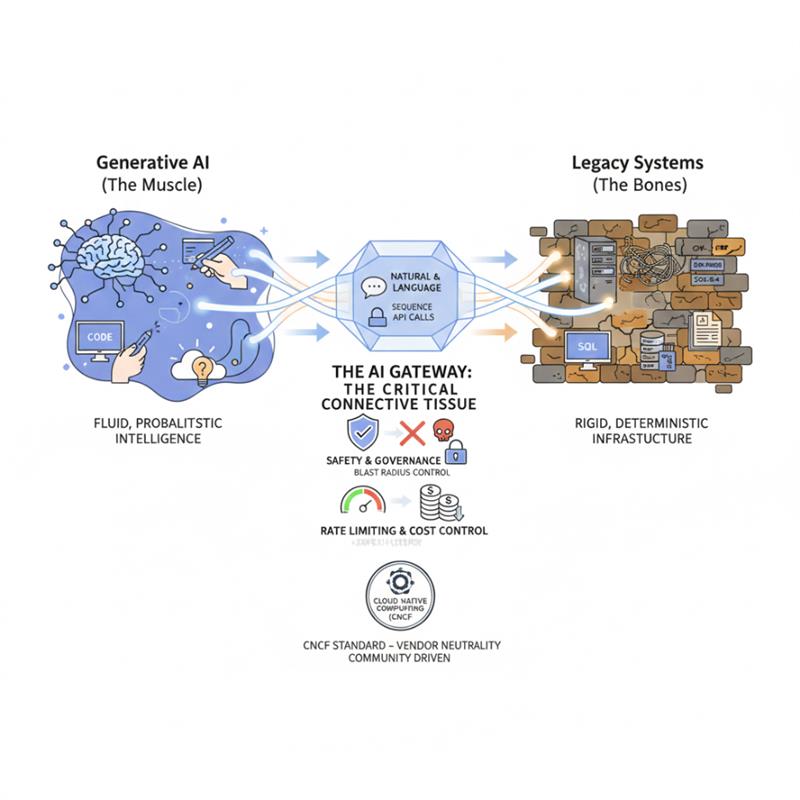
We may think of our legacy infrastructure as the bones of your organization that remain rigid, structural and essential. Think of GenAI as the new muscle that is powerful and capable of complex action. The AI Gateway is the tendon and ligament that translates the intent of the muscle into safe, coordinated movement of the bone.
An AI Gateway is more than just another API management tool. It is a specialized architectural layer designed to mediate the complex relationship between probabilistic AI models and deterministic backend services.
Why Legacy AI System Integration Needs This Critical Layer
- Translation and Orchestration:
Legacy systems speak in rigid protocols (SOAP, older REST, XML), while LLMs operate using natural language and embeddings. The AI Gateway acts as the translation layer, converting a user’s intent (for example, “Check the inventory for SKU-123 and update shipping”) into a precise, governed sequence of API calls that legacy systems can understand and execute. - Safety and Governance (The Blast Radius):
Autonomous AI agents must never have unrestricted access to core systems. The AI Gateway enforces strict policies on what data an AI can access and what actions it can perform. It serves as the ultimate gatekeeper, ensuring that even if an LLM hallucinates or generates an unsafe command, the request is blocked if it violates defined rules and protocols. - Rate Limiting and Cost Control:
Legacy systems are not designed to handle unpredictable, high-volume AI-driven traffic. The AI Gateway protects these systems by applying rate limits and throttling requests when necessary. At the same time, it helps control operational costs by managing and optimizing token usage when interacting with external LLM providers.
A Watershed Moment: The AI Gateway Moves to the CNCF
For a new technology to become true enterprise infrastructure, it needs to move beyond vendor-specific implementations and become a standard.
We are currently witnessing a pivotal moment where major AI Gateway initiatives are being donated to the Cloud Native Computing Foundation (CNCF). This is a massive signal of maturity for the ecosystem.When AI Gateway technology enters the CNCF (home of Kubernetes, Prometheus, and Envoy), it changes the game. It signals that connecting AI to legacy systems has become fundamental infrastructure.
- Standardization over Fragmentation:
It prevents a fractured landscape where each cloud provider defines its own method for connecting AI to backend systems. A CNCF-governed gateway offers a unified API surface for managing AI traffic, independent of the underlying model provider (such as OpenAI, Anthropic, or local Llama models) or the target legacy system. - Vendor Neutrality and Trust:
Enterprises are reluctant to lock their critical AI infrastructure into a single vendor. Open governance under the CNCF ensures long-term viability, transparency, and vendor neutrality, building trust across the ecosystem. - Community-Driven Velocity:
By open-sourcing this critical connective layer, innovation accelerates rapidly. The collective engineering strength of the community can address complex challenges—such as advanced RAG caching and semantic routing—faster than any single organization could on its own.
The movement of AI Gateways into the CNCF signifies that connecting AI to legacy isn’t a niche feature but a fundamental cloud-native infrastructure.
AI Gateway GitHub link: https://github.com/envoyproxy/ai-gateway
How Fusefy Adopts the Gateway for “Agentic” Action
Standardization is always great, but actually connecting AI agents to legacy infrastructure is where implementation gets real. This is where platforms like Fusefy are changing what’s possible.This is where platforms like Fusefy are leveraging this new architectural paradigm to change what’s possible on legacy tech.
Many current enterprise AI implementations are passive. They are “Chat with your PDF” bots. The goal here is Agentic AI: systems that can autonomously plan and execute multi-step tasks across different systems to achieve a goal.
Fusefy recognizes that you cannot build Agentic AI on legacy systems without a robust gateway layer. Here is how Fusefy adopts this architecture to enable agents:
- Turning Legacy APIs into “Tools”:
An LLM does not natively understand how to call SOAP services or other brittle legacy APIs. Fusefy uses the AI Gateway layer to wrap complex legacy endpoints into clean, semantic “tools” that AI agents can understand. The gateway exposes a simple definition (for example, function: update_customer_address) to the LLM, while abstracting away the underlying XML complexity required to execute the operation on the backend. - The Governance Sandbox:
When a Fusefy agent determines it needs to perform a large-scale operation—such as updating 500 records in a legacy ERP system based on a new pricing model—it does not act blindly. The AI Gateway intercepts and evaluates the agent’s plan by checking permissions, rate limits, and compliance rules. Fusefy depends on this governance layer to ensure that every agent action is controlled, auditable, and responsible. - Semantic Routing and Observability:
Fusefy leverages the AI Gateway for intelligent task routing. Simple requests may be directed to smaller, faster local models, while complex reasoning tasks are routed to more powerful models like GPT-4. Additionally, the gateway provides full observability, enabling a complete audit trail that traces an action from the original natural language prompt down to the exact backend database call executed on the legacy system.
Conclusion: The Bridge to the Future is Built on the Past
We aren’t going to rewrite billions of lines of legacy code overnight just to accommodate generative AI. The future belongs to organizations bridging the gap between new AI capabilities and existing infrastructure without breaking what already works. The future belongs to organizations that can effectively graft the new intelligence onto existing operations.
The AI Gateway is no longer an optional accessory; it is the essential connective tissue for the modern enterprise stack. Its evolution through CNCF governance ensures a stable foundation, and platforms like Fusefy are proving that with the right architecture, even the oldest legacy systems can become engines for autonomous, agentic innovation.
AUTHOR

Sindhiya Selvaraj
With over a decade of experience, Sindhiya Selvaraj is the Chief Architect at Fusefy, leading the design of secure, scalable AI systems grounded in governance, ethics, and regulatory compliance.
Similar Vibes



Top Vibes